Monday, September 3, 2012

Two Figures in Dense Violet Night.

I had as lief be embraced by the portier of the hotel
As to get no more from the moonlight
Than your moist hand.

Be the voice of the night and Florida in my ear.
Use dasky words and dusky images.
Darken your speech.

Speak, even, as if I did not hear you speaking,
But spoke for you perfectly in my thoughts,
Conceiving words,

As the night conceives the sea-sound in silence,
And out of the droning sibilants makes
A serenade.

Say, puerile, that the buzzards crouch on the ridge-pole
and sleep with one eye watching the stars fall
Beyond Key West.

Say that the palms are clear in the total blue.
Are clear and are obscure; that it is night;
That the moon shines.

Gubbinal.

That strange flower, the sun,
Is just what you say.
Have it your way.
The world is ugly,
And the people are sad.
That tuft of jungle feathers,
That animal eye,
Is just what you say.
That savage of fire,
That seed,
Have it your way.
The world is ugly,
And the people are sad.

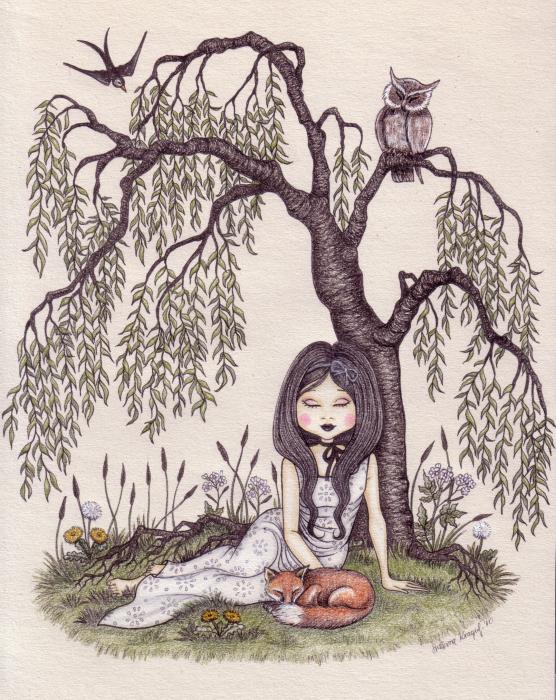
Jasmine's Beautiful Thoughts Underneath The Willow.

My titillations have no foot-notes
And their memorials are the phrases
Of idiosyncratic music.

The love that will not be transported
In an old, frizzled, flambeaud manner,
But muses on its eccentricity,

Is like a vivid apprehension
Of bliss beyond the mutes of plaster,
Or paper souvenirs of rapture,

Of bliss submerged beneath appearance,
In an interior ocean's rocking
Of long, capricious fugues and chorals.

Sonatina to Hans Christian.

If any duck in any brook,
Fluttering the water
For your crumb,
Seemed the helpless daughter

Of a mother
Regretful that she bore her;
Or of another,
Barren, and longing for her;

What of the dove,
Or thrush, or any singing mysteries?
What of the trees
And intonations of the trees?

What of the night
That lights and dims the stars?
Do you know, Hans Christian,
Now that you see the night?

Friday, August 31, 2012

You May Have Noticed.

Some blogs on the blogroll will give you an "error" message or won't open. Don't worry, this just means they (or you!) haven't posted yet. Once there's posts to direct to, the blogroll will start working fine all on its own.

I Have No Life, Except In Poetry.

How in the world could Wallace Stevens write poetry for children?

Everyone should have their blog url sent by Tuesday! Your blog will be the most important assignment in this class, so be sure to make it interesting for your classmates. Exemplary blogs will be displayed.

The planet on the table refers to the book!

James' dream of a buck with red eyes in a dark alleyway; bucks are passion and the firecat is your psychic intuition.

Are Stevens' poems for children, or are they for the children in us? They celebrate the marriage of sky and earth and water, to recreate this period in all of our lives when we were not yet aware. Learning to speak is your downfall – you learn to speak and lose your innocence. The poems are not just about synesthesia or dyslexia, they are synesthetic and dyslexic.

Wallace Stevens only talks about one subject, and once you know it, all of his poems make sense. One must always keep the dance between imagination and reality in mind, but which one is which?

Think of all the poems in this way and things will become a lot less clear than they were before. He believes that we have lost sight of the earth and we need to regain that consciousness

  • Everything is made of invisible particles
  • They are indestructible and eternal
  • The elementary particles are infinite in number but limited in shape and size
  • All particles are in motion in an infinite void
  • The universe has no creator or designer
  • Everything comes into being as a result of the swerve

The ceaseless mutation of forms composed of indestructible substances is the greatest thought that mankind has ever hit upon.

To An Old Philosopher In Rome.

On the threshold of heaven, the figures in the street
Become the figures of heaven, the majestic movement
Of men growing small in the distances of space,
Singing, with smaller and still smaller sound,
Unintelligible absolution and an end -

The threshold, Rome, and that more merciful Rome
Beyond, the two alike in the make of the mind.
It is as if in a human dignity
Two parallels become one, a perspective, of which
Men are part both in the inch and in the mile.

How easily the blown banners change to wings...
Things dark on the horizons of perception
Become accompaniments of fortune, but
Of the fortune of the spirit, beyond the eye,
Not of its sphere, and yet not far beyond,

The human end in the spirit's greatest reach,
The extreme of the known in the presence of the extreme
Of the unknown. The newsboys' muttering
Becomes another murmuring; the smell
Of medicine, a fragrantness not to be spoiled...

The bed, the books, the chair, the moving nuns,
The candle as it evades the sight, these are
The sources of happiness in the shape of Rome,
A shape within the ancient circles of shapes,
And these beneath the shadow of a shape

In a confusion on bed and books, a portent
On the chair, a moving transparence on the nuns,
A light on the candle tearing against the wick
To join a hovering excellence, to escape
From fire and be part only of that which

Fire is the symbol: the celestial possible.
Speak to your pillow as if it was yourself.
Be orator but with an accurate tongue
And without eloquence, O, half-asleep,
Of the pity that is the memorial of this room,

So that we feel, in this illumined large,
The veritable small, so that each of us
Beholds himself in you, and hears his voice
In yours, master and commiserable man,
Intent on your particles of nether-do,

Your dozing in the depths of wakefulness,
In the warmth of your bed, at the edge of your chair,
alive
Yet living in two world, impenitent
As to one, and, as to one, most penitent,
Impatient for the grandeur that you need

In so much misery; and yet finding it
Only in misery, the afflatus of ruin,
Profound poetry of the poor and of the dead,
As in the last drop of the deepest blood,
As it falls from the heart and lies there to be seen,

Even as the blood of an empire, it might be,
For a citizen of heaven though still of Rome.
It is poverty's speech that seeks us out the most.
It is older than the oldest speech of Rome.
This is the tragic accent of the scene.

And you - it is you that speak it, without speech,
The loftiest syllable among loftiest things,
The one invulnerable man among
Crude captains, the naked majesty, if you like,
Of bird-nest arches and of rain-stained-vaults.

The sounds drift in. The buildings are remembered.
The life of the city never lets go, nor do you
Ever want it to. It is part of the life in your room.
Its domes are the architecture of your bed.
The bells keep on repeating solemn names

In choruses and choirs of choruses,
Unwilling that mercy should be a mystery
Of silence, that any solitude of sense
Should give you more than their peculiar chords
And reverbations clinging to whisper still.

It is a kind of total grandeur at the end,
With every visible thing enlarged and yet
No more than a bed, a chair and moving nuns,
The immensest theatre, and pillared porch,
The book and candle in your ambered room,

Total grandeur of a total edifice,
Chosen by an inquisitor of structures
For himself. He stops upon this threshold,
As if the design of all his words takes form
And frame from thinking and is realized.

Anecdote of a Jar.

I placed a jar in Tennessee,
And round it was, upon a hill.
It made the slovenly wilderness
Surround that hill.

The wilderness rose up to it,
And sprawled around, no longer wild.
The jar was round upon the ground
And tall and of a port in air.

It took dominion every where.
The jar was gray and bare.
It did not give of bird or bush,
Like nothing else in Tennessee.

An Earthy Anecdote.

Every time the bucks went clattering
Over Oklahoma
A firecat bristled in the way.

Wherever they went,
They went clattering,
Until they swerved
In a swift, circular line
To the right,
Because of the firecat.

Or until they swerved
In a swift, circular line
To the left,
Because of the firecat.

The bucks clattered.
The firecat went leaping,
To the right, to the left,
And
Bristled in the way.

Later, the firecat closed his bright eyes
And slept.

Wednesday, August 29, 2012

The Snow Man.

One must have a mind of winter
To regard the frost and the boughs
Of the pine-trees crusted with snow;

And have been cold a long time
To behold the junipers shagged with ice,
The spruces rough in the distant glitter

Of the January sun; and not to think
Of any misery in the sound of the wind,
In the sound of a few leaves,

Which is the sound of the land
Full of the same wind
That is blowing in the same bare place

For the listener, who listens in the snow,
And, nothing himself, beholds
Nothing that is not there and the nothing that is.